|
|

G.SHDSL/CAP/2B1Q - 1 or 2 pairs
|
The Family of Symmetrical DSL Modems |
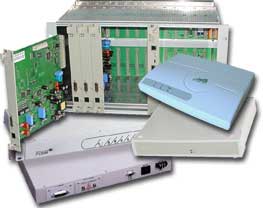
AccessDSL is a wide range of DSL modems targeted to meet both
typical carrier applications and access network needs. |
Main Features |
• G.SHDSL (one or two
pair), CAP, 2B1Q
• E1 and Nx64 Interfaces
• Multi-service
• Multipoint
• Ethernet 10/100BaseT, Bridge, Router
• Voice Interfaces (IAD functionality)
• Voice over IP Add Drop Repeater
• Single and Dual port LTUs
• Remote or Local Power
• Tabletop/ Subrack
• VT100, Telnet or SNMP Management
• Wetting Current
• Extended Temperature Range
• Easy software upgrade with Flash Loader
• High Quality, High Performance |
 |
|
AccessDSL’s flexibility lets
you choose one of three line coding options (G.SHDSL, CAP or 2B1Q)
depending on your PTT requirements and technology preference. Similarly
multiple options on the user-side interfaces include G.703/704,
N*64(V.35, V.36, X..21), 10BaseT and RS232/485. If you want to offer
combined voice and data services in one package, AccessDSL supports
Integrated Access Device (IAD) functionality providing 4 or 8 voice
interfaces in parallel with data transmission. AccessDSL series Modems
can be delivered in two different mechanical designs to meet CO, campus
and SOHO needs: a subrack plug-in card version for installation into a
universal 19“ 6U AccessDSL subrack or a stand-alone version for desktop
use. |
The AccessDSL Modems – Technology
|
AccessDSL G.SHDSL New Generation Modems are based
on the latest DSL line technology-TC-PAM. TC-PAM was designed to
provide both superior distance and full electromagnetic spectral
compatibility with other DSL services running in one cable. TC-PAM is
documented in the standards of ANSI HDSL2 as well as ETSI SDSL. It is
also the first international ITU G.SHDSL standard for symmetrical
1-pair-high-speed data transmission over existing copper pairs. An
advantage of this technology is also the interoperability of a wide
range of manufacturers’ transmission devices.
AccessDSL provides high availability even for harsh environments due
to features such as wetting current and the choice of extended
temperature range components. The options of different line-codes, one
or two pair operation and availability of repeaters allows coverage of
nearly all applications. All units have their own on-board
microprocessor, DC/DC power converters and clock recovery circuits,
resulting in extremely high overall system reliability. |
|
|
|
|
 Flexible Access Solutions